Middle East — Country Profile
Qatar
Population
3.19 million
GDP
217.42 billion USD
Literacy Rate
98.5%
Life Expectancy
81.2 years
Net Migration
12.4 per 1000
Gender Index
0.855
Economic Indicators
Key Trends (2015–2026)
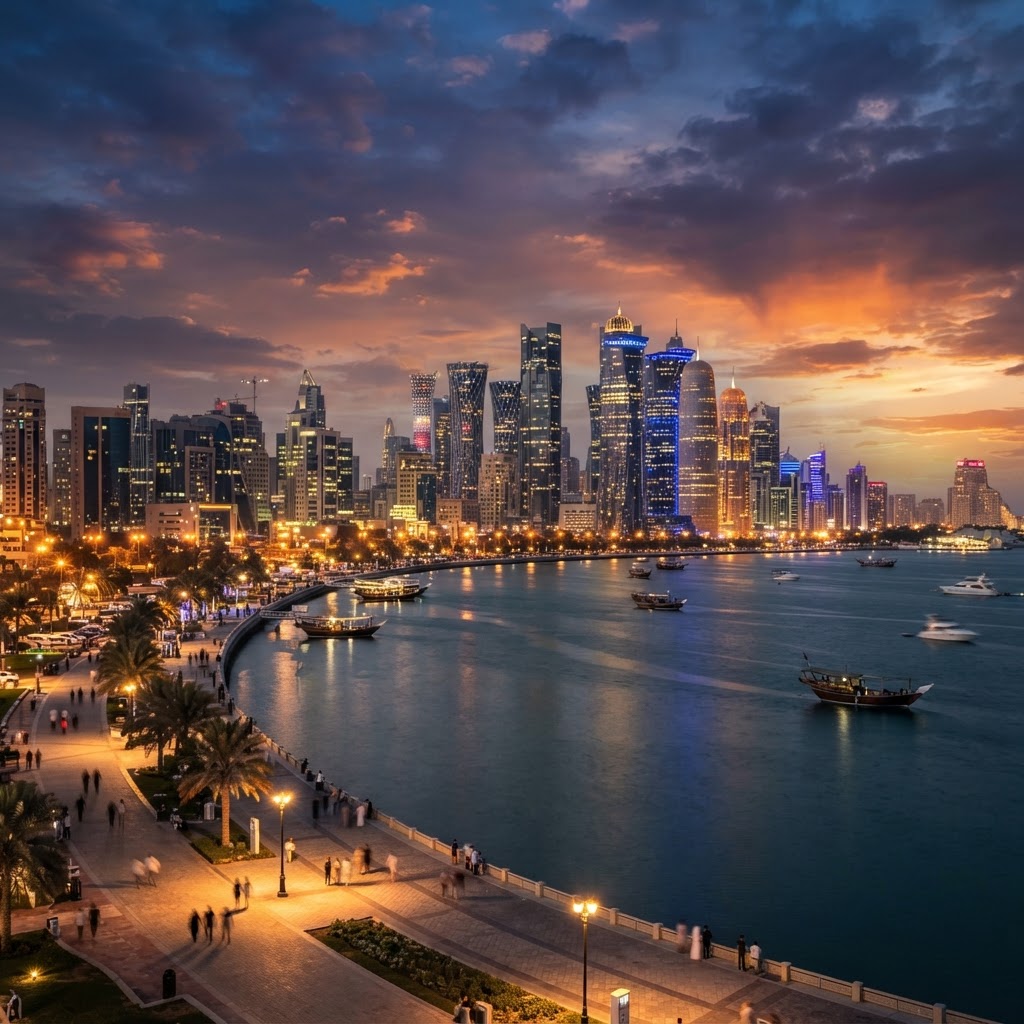
Qatar is a peninsular Arab nation situated on the northeastern coast of the Arabian Peninsula, occupying a landmass of approximately 11,571 square kilometers that juts northward into the Persian Gulf. As of August 2026, the country maintains a population of 3.19 million people, a figure that reflects both a modest citizen base and a dominant expatriate majority drawn by economic opportunity. Ruled by the Al Thani family since the mid-nineteenth century, the emirate has undergone a remarkable transformation from a subsistence pearling and fishing economy into one of the wealthiest nations on earth by per-capita income measures. The discovery and subsequent commercialization of vast natural gas reserves beneath the North Field, the world's single largest natural gas reservoir, fundamentally redefined the country's global standing and fiscal capacity. Qatar's geography is dominated by flat, arid desert terrain with a long and strategically significant coastline that has enabled the development of world-class port infrastructure and liquefied natural gas export terminals. Life expectancy stands at 81.2 years, a figure that compares favorably with advanced industrial economies and reflects the state's substantial investment in healthcare infrastructure and public services. As of mid-2026, Qatar continues to serve as a key mediator in several regional and international conflicts, leveraging its wealth and relative political neutrality to facilitate dialogue between otherwise adversarial parties. The country's literacy rate of 98.5 percent underscores the success of sustained investment in education over multiple decades, contributing to a skilled and increasingly knowledge-oriented workforce. Qatar's strategic position within the Gulf Cooperation Council and its independent foreign policy posture have allowed it to maintain functional relationships with actors across ideological and geopolitical divides. The nation's GDP reached 217.42 billion USD, cementing its status as one of the highest-income economies in the Arab world and globally. National development ambitions are codified under the Qatar National Vision 2030, a comprehensive framework that targets economic diversification, environmental sustainability, human development, and social cohesion. The country's influence in global energy markets is substantial, and its role as a primary supplier of liquefied natural gas to European and Asian markets gained renewed strategic importance in the context of post-2022 global energy realignments. Qatar's diplomatic footprint extends well beyond its geographic size, with active roles in conflict mediation in Afghanistan, Gaza, and the Horn of Africa contributing to its reputation as an indispensable interlocutor. The emirate's migration rate of 12.4 per 1,000 people reflects the continuous inflow of foreign labor and professional talent that sustains its ambitious infrastructure and service sectors. In sum, Qatar represents a distinctive geopolitical and developmental case study, combining extraordinary resource wealth, assertive diplomacy, and an accelerating modernization agenda within a traditional monarchical governance structure.

