Africa — Country Profile
Egypt
Population
116.5 million
GDP
430 billion USD
Literacy Rate
76.8%
Life Expectancy
71.5 years
Net Migration
-0.5 per 1000
Gender Index
0.685
Economic Indicators
Key Trends (2015–2026)
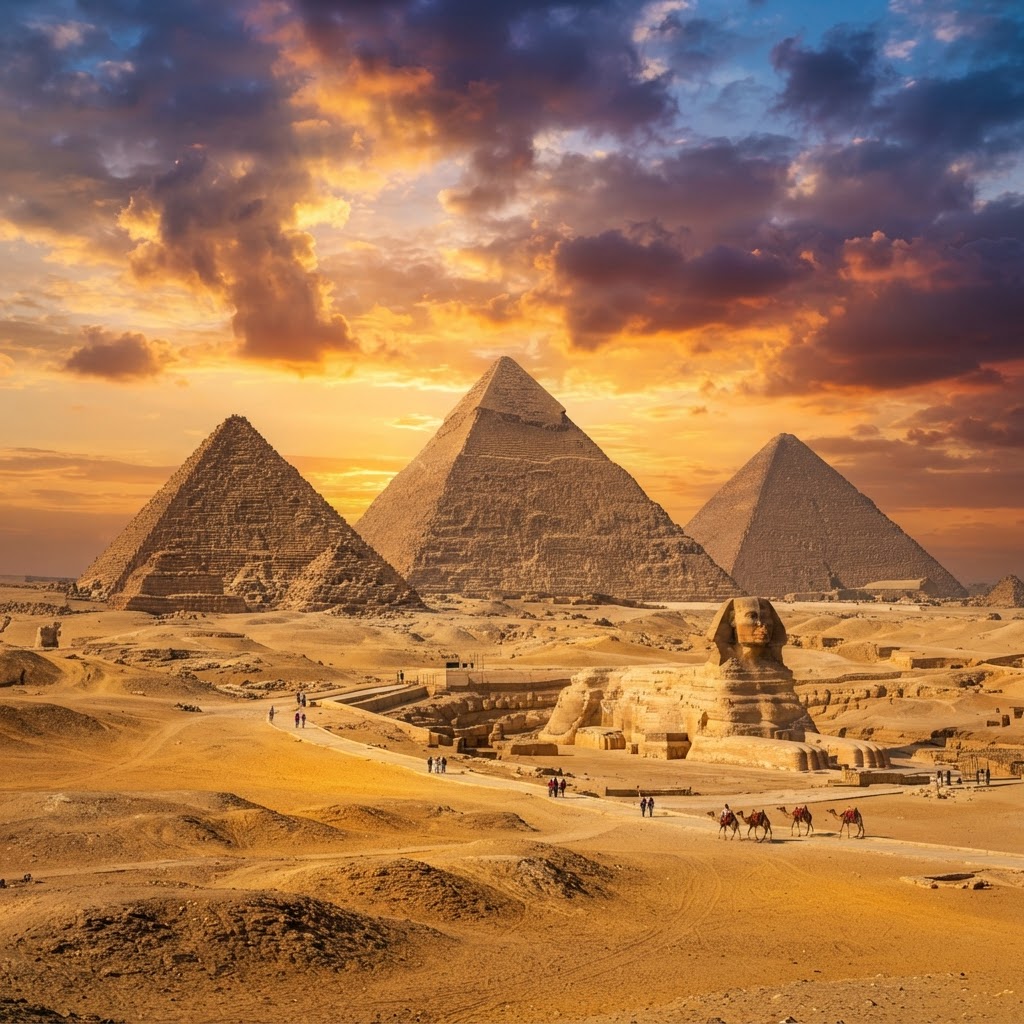
Egypt occupies a vital strategic position at the crossroads of Africa and the Middle East, serving as a geographic and cultural bridge between two of the world's most dynamic regions. As of August 2026, the country is home to approximately 116.5 million people, making it the most populous nation in the Arab world and the third most populous on the African continent. The Suez Canal remains one of the most critical arteries in global maritime trade, channeling roughly 12 to 15 percent of global trade volume and generating substantial revenues that underpin the national budget. Egypt's economy, valued at approximately 430 billion USD, has demonstrated a consistent upward trajectory, with GDP growth accelerating from 2.4 percent in 2024 to a projected 4.6 percent in 2026, reflecting the success of ongoing stabilization efforts. The Nile River continues to serve as the lifeblood of Egyptian civilization, supporting agriculture, freshwater access, and population concentration along its fertile delta and valley. Life expectancy stands at 71.5 years, a figure that reflects both the progress and the continuing challenges within Egypt's healthcare and public services infrastructure. Geopolitically, Egypt remains a pivotal actor in the Middle East and North Africa region, leveraging its historical prestige and institutional capacity to mediate conflicts and foster diplomatic dialogue. The government has committed to a broad modernization agenda that encompasses infrastructure development, digital transformation, and social reform. Regional tensions, including ongoing instability in Gaza, Sudan, and Libya, continue to shape Egypt's foreign policy calculus and domestic security priorities. The country's strategic depth is further reinforced by its membership in key multilateral institutions and its close partnerships with Gulf states, the European Union, and the United States. Egypt's literacy rate of 76.8 percent, while showing improvement over previous decades, still reflects significant disparities between urban and rural populations and between genders. The migration rate of negative 0.5 per 1,000 people indicates a modest net outflow, driven primarily by skilled workers seeking economic opportunities abroad while the country simultaneously absorbs large numbers of refugees from neighboring conflict zones. The government's Vision 2030 framework and its alignment with the United Nations Sustainable Development Goals provide a coherent long-term roadmap for national development. Political stability, economic reform, and demographic management remain the three most defining challenges and opportunities for Egypt heading into the latter half of the 2020s. Egypt's trajectory as of August 2026 suggests cautious optimism, grounded in measurable economic improvements but tempered by persistent structural vulnerabilities.

